A rural gem in central Alabama’s Black Belt, Lowndes County today retains its many green spaces and agricultural nature. In addition to encouraging young families to engage in the farming tradition, the area’s communities are actively pursuing new avenues of economic development. Lowndes is a living testament to the changes brought about by the Voting and Civil Rights Movements, and is the birthplace of the Black Panther Party. Each April since 1972, the town of Fort Deposit has hosted the annual Calico Fort Arts and Crafts Fair, one of the Southeast’s oldest and largest such arts events.
People Who Shaped Lowndes County
On March 22, 1965, the Selma to Montgomery marchers awoke to begin the second day of their journey. Marchers would walk along Highway 80 until they had gotten to the farm of Ms. Rosie Steele. Legend goes that Ms. Steele was asked by Mr. Stokley Carmichael and Mr. Bob Mants, if the marchers could stay on her property, Ms. Steele did not hesitate to agree to do so. Ms. Steele was widowed early in her life and was left to raise her family, which she did with elegance, grit, and grace. Ms. Steele was a farmer and entrepreneur, she owned and operated a store next to her home on Highway 80. Family members remember her generosity to the community, it did not matter to Ms. Steele if you had the money to pay, she would never allow someone in need to leave empty handed.
The Jackson Family was one of the major supporters of the Student Nonviolent Coordinating Committee when they began their work in the Black Belt. Matthew and Emma Jackson and their ten children became volunteers as well as important ambassadors introducing the organization to the rural community. The Jacksons allowed SNCC to use an empty home on their property for meetings as well as a safe place to stay. This house became known as the Freedom House.
Stokely Carmichael was one of the original SNCC freedom riders, and became heavily involved in the Voting Rights Movement in Alabama during the early 60s. As a part of his work to register African Americans to vote, he began to develop an independent political organization to equitably represent black people and their interests. The Lowndes County Freedom Organization and eventually the Black Panther Party became extensions of this effort.
John Hulett was a civil rights activist, sheriff, and judge for Lowndes County, Alabama. Hulett joined the National Association for the Advancement of Colored People (NAACP) and Alabama Christian Movement for Human Rights and was a full-time supporter of the Student Non-Violent Coordinating Committee (SNCC) to encourage African American voter registration. Hulett helped organize the Lowndes County Freedom Organization (LCFO), which would run black candidates for county level positions, known as the “Black Panther Party,” and was elected its chairman.
Places in Lowndes County
In the heart of Lowndes County at the site of the Lowndes County Interpretive Center lies a profound chapter of American history born out of the turbulence and tenacity of the Civil Rights Movement. Tent City emerged in the mid-1960s as a stark testament to the struggle for equality and justice. This temporary encampment was established when African American tenant farmers and sharecroppers were evicted from their homes by white landowners in retaliation for their attempts to register to vote.
Deprived of shelter and stability, families found refuge in Tent City, transforming it into a symbol of resistance and resilience. Despite the rudimentary living conditions, the spirit of community thrived.
Men, women, and children persevered from within these modest quarters. Support from civil rights organizations, particularly the Student Nonviolent Coordinating Committee (SNCC), provided essential aid and bolstered the morale of those who had lost nearly everything in their pursuit of equality. Tent City became more than just a shelter; it was a defiant statement against systemic oppression. Tent City’s legacy endures, ensuring that the voices of those who once called it home are not forgotten.
Learn More
Get Directions
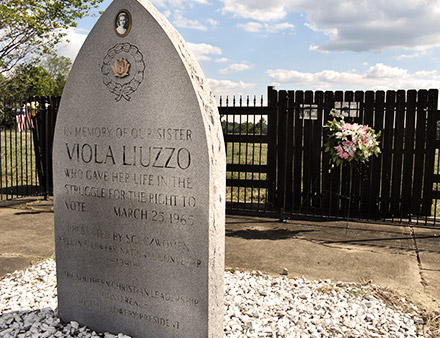
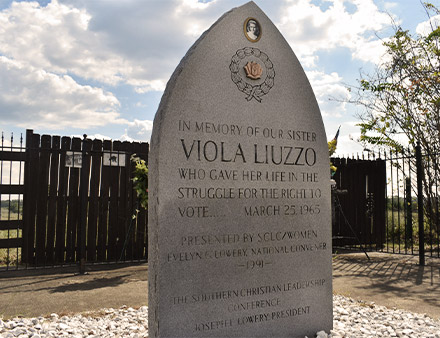
The Viola Liuzzo Memorial is located in Lowndes County, Alabama, on U.S. Highway 80 along the Selma to Montgomery National Historic Trail. The marker was erected in 1991 at the site of her murder by members of the Ku Klux Klan on March 25, 1965.
The memorial commemorates the life and legacy of Liuzzo, a white woman and married mother of five from Detroit, Michigan who traveled south to support the Voting Rights March. The large granite monument features the words, “In Memory of Our Sister Vila Liuzzo Who Gave Her Life in the Struggle for the Right to Vote….” A garden at the site offers a bench for visitors to reflect.
Learn More
Get Directions
The Lowndes Interpretive Center is dedicated to commemorating the Selma to Montgomery March of 1965. The center showcases exhibits on events and figures like the tragic deaths of Jonathan Daniels and Viola Liuzzo and the establishment of “Tent City.” Part of the Selma to Montgomery National Historic Trail, the building serves as a place of reflection on the sacrifices made for Civil Rights. Visitors can explore interactive displays, historical artifacts, and multimedia presentations bringing stories of the march to life.
Established by the Student Nonviolent Coordinating Committee (SNCC) in the mid-1960s, this complex became a crucible for change, fostering the efforts of young activists dedicated to dismantling the entrenched systems of segregation and disenfranchisement. The Freedom Complex served as both a strategic headquarters and a sanctuary for those who risked everything to secure the fundamental rights denied to African Americans in the Deep South.
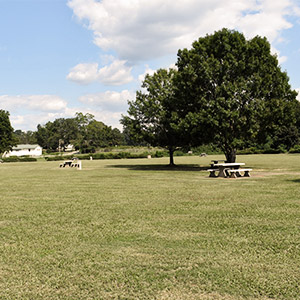
One of the significant battles of the Creek War of 1813-14 occurred near here on December 23, 1813. The 3rd Regiment, U.S. Infantry forces under the command of General F. L. Claiborne attacked a band of Creek Indians at the site known as “Holy Ground” by Creeks. The area is now a beautiful park perfect for recreational activities year-round.