Long before European settlements, the area around Selma was home to the Creek people and their ancestors for thousands of years. Initially known as Ecor Bienville by French settlers and later as Moore’s Bluff, the small town was renamed Selma in 1820. In its infancy, Selma was a modest community near Alabama’s first capital at Cahawba. Its growth surged after the capital relocated to Tuscaloosa, and as the cotton economy flourished, Selma emerged as a pivotal market and trade center due to its strategic river location. This expansion was further accelerated by the chartering of a new railroad line.
Sites in Selma
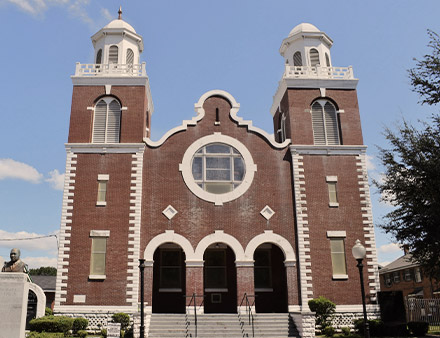
Built in 1908, Brown Chapel A.M.E. has faithfully serve the Black community since its founding. In the early months of 1965 churches across Selma began hosting nonviolent training sessions for community members, mostly made up of young black boys and girls. The people of Perry County and Dallas County were still processing the murder of Mr. Jimmie Lee Jackson, when on March 7, 1965, over 600 people gathered at the Brown Chapel A.M.E., their focus, a march from Selma to Montgomery. Led by Mr. Albert Turner, Mr. John Lewis of SNCC and Mr. Hosea Williams of the SCLC marchers set out to Montgomery but were met with a wall of law enforcement agencies a few blocks from the church at the base of the Edmund Pettus Bridge. Marchers were beaten and chased back to Brown Chapel A.M.E. and other places. Brown Chapel A.M.E. would serve as a triage center for wounded marchers, several children were among the wounded. Brown Chapel would also serve as the starting point for “Turn Around Tuesday” and the successful march from Selma to Montgomery, that began on March 21, 1965. With its stately towers and Romanesque Revival styling, Brown Chapel A.M.E. still serves the Black Belt and serves as a place the world gathers to learn about the history of voting rights in America.
Learn More
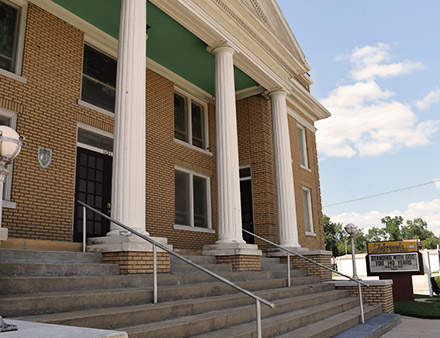
Tabernacle Baptist Church was organized in 1884 as a place of worship for the emerging middle class of Blacks and for students at Selma University. In May 1963 Rev. Dr. Bernard Lafayette began having mass meetings in the church, educating the young people of Selma about nonviolent resistance. These mass meetings were instrumental in laying the foundation for the fight for voting rights in Selma and the South, leading to Bloody Sunday and ultimately the passage of the Voting Rights Act of 1965. Historic Tabernacle Baptist Church was listed on the National Historic Registry of Historic Places in 2013
Learn More
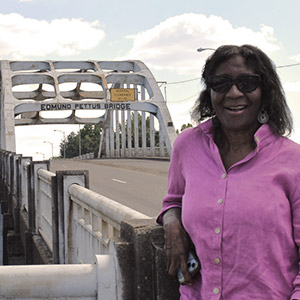
The Edmund Pettus Bridge, erected in 1939, spans the Alabama River in downtown Selma. Named for Edmund Winston Pettus, a former Confederate Brigadier General and U.S. Senator from Alabama, this bridge has transcended its original purpose to become a powerful symbol of the Civil Rights Movement. The bridge is etched into history as the site of the momentous Selma to Montgomery Marches and the infamous “Bloody Sunday.” On March 7, 1965, peaceful protesters attempting to march from Selma to Montgomery were met with brutal force by law enforcement on this very bridge.
The shocking violence of that day, broadcasted across the nation, galvanized support for the civil rights cause and was instrumental in the passage of the U.S. Voting Rights Act of 1965. In recognition of its profound historical significance, the Edmund Pettus Bridge was added to the National Register of Historic Places and declared a National Historic Landmark in 2013. It is also an integral part of The Selma to Montgomery National Historic Trail, administered by the National Park Service. It is expected to become a UNESCO World Heritage Site in the near future.
Learn More
Get Directions
Key Events
A native of Tampa Florida, Dr. Bernard Lafayette saw early on the relationship between whites and blacks, when he saw his grandmother disrespected on a streetcar in Florida. By the time Dr. Lafayette made it to Selma he had already had an impressive resume working to advance civil rights. He attended the Highlander School, was a part of the Nashville Movement, and participated in the Freedom Rides where he was beaten alongside John Lewis in Montgomery, AL.
In the spring of 1963 Dr. Lafayette became the Director of the Student Nonviolence Coordinating Community (SNCC) Alabama voter registration and moved to Selma, one of the most dangerous places for a civil rights activist. Dr. Lafayette began holding nonviolence workshops in Selma and his efforts helped trained community members and young people to prepare for the many battles ahead for Blacks to gain the right to vote.
After the Civil War, freed slaves began to work and establish lives and industry. In places like Selma, schools were opened to educate the children of formerly enslaved people. Universities were created, and an educated class began to flourish. Teachers, professors, doctors, dentists, lawyers all began to create the need for institutions that would serve this emerging middle class. With this education and industry, homes were built and neighborhoods developed for the community. Even so, there was still a power structure that existed that prevented African Americans from having equality with their white neighbors.
Reverend Frederick D. Reese, a minister and educator in Dallas County, organized a group of 105 African American teachers to participate in the “Teachers March” for voting rights. The march began at Clark Elementary School and ended at the Dallas County Courthouse. Rev. Reese was repeatedly assaulted by Sheriff Jim Clark while attempting to enter the Courthouse to register to vote until the protestors led by Reese headed to the Brown Chapel A.M.E. Church. This march was seen as a victory for the Voting Rights Movement and provided momentum for the movement as voting rights became a larger issue in Washington, D.C.
Nearly 10 years after the beginning of the modern Civil Rights Movement, over 600 people gathered at Brown Chapel A.M.E. Church for one of the last great battles of the movement. Marchers had gathered because of the large number of Blacks who were being disenfranchised, for no other reason than the color of their skin, and because of the death of Mr. Jimmie Lee Jackson.
Led by a local activist from Marion, Albert Turner, Mr. John Lewis of CORE, and Mr. Hosea Williams of SCLC, the Marchers left Brown Chapel walking in two rows along Sylvan Street and made a right turn on Water Avenue and then a left turn on Broad Street and over the Edmund Pettus Bridge. As Marchers walked over the Edmund Pettus Bridge, they saw a wall of law enforcement officers. When the marchers got to the bottom of the bridge they were told to stop and were given two minutes to disperse. Law enforcement did not give them the entire two minutes, instead they rush toward the protestors with Billy clubs raised and began beating the marchers. On the bridge that day men, women, and children from mostly Dallas and Perry Counties, were beaten and trampled by horses and chased through the streets of Selma. Several were hospitalized, John Lewis suffered a broken skull. Caught on camera and shown to the world, the event that took place on March 7, 1965 helped push the President of the United States and the Congress of the United States to pass the Voting Rights Act of 1965, thereby eventually doing away with a jim crow system in the south that had been in place since the end of the Civil War and finally allowing Blacks the right to vote one hundred and seventy-nine years after George Washington was first elected to office and one hundred years after the end of the civil war.