With the state’s largest historic district, Dallas County is proud of its heritage while actively working toward a bright future. Located in the heart of the Alabama Black Belt region, the county provides businesses four industrial parks in the area, and gives farmers and foresters an ideal setting for growing throughout the year. Paul M. Grist State Park is a great setting for fishing, hiking, and other outdoor activities. And of course, the City of Selma offers a myriad of opportunities to explore history that has shaped the world.
Dallas County Website
People Who Shaped Dallas County
Founded in 1920 by Mr. Charles Adams, the Dallas County Voters League had a history of working on getting Blacks the right to vote since it’s earliest beginnings. The organization was once led by Mr. Samuel Boynton and in 1960 led by Mr. F.D. Reese. Under the leadership of the “Courageous Eight,” the DCVL supported the efforts of Dr. Bernard Lafayette as he held nonviolent training sessions in Selma, the first mass meeting held by Dr. Lafayette was held at Tabernacle Baptist Church. DCVL also asked for the support of Dr. Martin Luther King Jr and the Southern Christian Leadership Conference. The Dallas County Voters League were instrumental in marshalling local support from the Foot Soldiers that was needed for the fight for voting rights. President of DCVL Mr. F.D. Reese, led a “Teachers March” in January 1965, where over 100 Black Teachers marched to the Dallas County Court House to demand the right to vote. Having been motivated by the courage of the teachers, students from R. B. Hudson High School began to walk out of school to protest, many kids were arrested.
An event 27 miles away in Marion, a small community in Perry County would highlight the brutality in the Selma community as well. On February 18, 1965 a black man, an Army Veteran, Mr. Jimmie Lee Jackson was shot by law enforcement, eight days later he died. Local leadership in consultation with SCLC and Dr. King began planning a march as a result of Mr. Jackson’s death. It was determined that a march from Selma to Montgomery would be the safest route and on March 7, 1965, over 500 people set out from Brown Chapel A.M.E. Church headed to Montgomery. The marchers had gone about 6 blocks when they were met with a wall of law enforcement officials at the base of the Edmund Pettus Bridge, unprovoked, law enforcement officers began beating the marchers, several of whom were DCVL members, including Mrs. Amelia Boynton. DCVL members would also participate in “Turn Around Tuesday” and the successful march from Selma to Montgomery held from March 21, 1965 to March 25, 1965.
Dr. William H. Dinkins moved to Selma from Marion in 1890 when his father was named president of Selma University. After he graduated from Selma University, he worked at the Burwell Infirmary prior to enrolling at Brown University. He taught for almost four decades at Selma University prior to his retirement. He was married to married to Almeida Burwell, the daughter of L.L. Burwell.
Mr. Fredrick Douglass Reese was born in Selma, AL on November 29, 1929. Mr. Reese would go on to graduate from Alabama State University with a master’s degree in Math and Science. Mr. Reese would marry, Alline Crossing, and move back to Selma in 1960 where he began teaching at R. B. Hudson High School and he joined the Dallas County Voters League. Mr. Reese became president of the DCVL and invited Dr. Martin Luther King Jr. and Southern Christian Leadership Conference to Selma to support efforts for Blacks to be able to vote. He was one of the “Courageous Eight,” of the Dallas County Voters League that included Amelia Boynton, Ulysses S. Blackmon, James E. Gildersleeve, Rev. John Hunter, Rev. Henry Shannon, Earnest Doyle, and Marie Fost.
On January 22, 1965, Mr. Reese would lead over 100 Black Teachers on a march to the Dallas County Courthouse to register to vote. Mr. Reese and the Teachers were not allowed in the building and was aggressively push away by law enforcement. The actions of Mr. Reese and the Black Teachers of Selma, galvanized students at R. B. Hudson to begin marching for their rights as well as the rights of their parents. Mr. Reese played pivotal roles before and after Bloody Sunday, as one of the leading citizens fighting for civil rights in Selma. The city of Selma designated March 21st of every year to be, “F.D. Reese Day.”
Mrs. Amelia Boynton was born in Georgia in 1905 one of nine children. Her parents pushed her and her siblings to get their education, which Mrs. Boynton would go on to graduate from Tuskegee Institute as it was known at the time, it is now Tuskegee University. Understanding the power of voting, Mrs. Boynton was registered to vote in 1934, one of the very few Blacks who were registered to vote in Alabama.
Mrs. Boynton helped revitalized the Dallas County Voters League and was member of the “Courageous Eight) in the 1960s, the DCVL became the local on the ground organization that worked with the larger national civil rights organizations like CORE, SNCC, and the SCLC. Mrs. Boynton was personally responsible for recruiting the Rev. Martin Luther King Jr. to come to Selma to help fight for the right to vote.
On March 7, 1965, Mrs. Boynton was one of the close to 600 marchers that were on the Edmund Pettus Bridge during Bloody Sunday. Mrs. Boynton, fifty-nine years old at the time, was severely beaten by law enforcement officers on the bridge, hit with a Billy club on her shoulder and neck and knocked unconscious. The picture of Mrs. Boynton laying on the ground was shown around the world. Under the heroic leadership and actions of Mrs. Boynton the Voting Rights Act of 1965 would be signed.
Ms. Joanne Bland was born on July 29, 1953 in Selma, AL . Encourage by her Grandmother Ms. Bland got involved in the fight for equality at 8 years and by the time she was 11 years old she had been arrested 13 times and was a child “Foot Soldier.” Ms. Bland witnesses Bloody Sunday and had a front row seat to the history changing events that took place in 1965.
After fighting this nation for her civil rights, Ms. Bland would go on to serve her nation in the United States Army and continues to serve her community as the leader of the nonprofit, Foot Soldiers Park.
March 21, 1965 the Selma to Montgomery march began, on that first day of the 54 mile trek, marchers would walk 7 miles from Selma, their first stop, the David Hall Farm. Mr. David Hall purchase his farm of 80 acres in 1940, raised his family, and was a very good steward of his land. He also worked at the George Washington Carver Homes in Selma, his employment there may have played a role in how his farm was selected to be a stop on the Selma to Montgomery march. According to some family members Mr. Hall kept his plans to allow marchers to stay a secret and some found out only when they began to arrive and others found out from the news media. Mr. Hall was a loving and kind man, he died before he was ever allowed to vote, but his actions made it possible for his children and grandchildren to have that right. His efforts to allow marchers to rest at his home, brought retaliation from some, but to this very day, the descendants of Mr. Hall still own and live on the 80 acres, seven miles from Selma.
Places in Dallas County
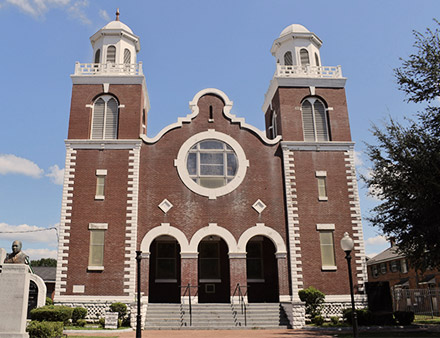
Built in 1908, Brown Chapel A.M.E. has faithfully serve the Black community since its founding. In the early months of 1965 churches across Selma began hosting nonviolent training sessions for community members, mostly made up of young black boys and girls. The people of Perry County and Dallas County were still processing the murder of Mr. Jimmie Lee Jackson, when on March 7, 1965, over 600 people gathered at the Brown Chapel A.M.E., their focus, a march from Selma to Montgomery. Led by Mr. Albert Turner, Mr. John Lewis of SNCC and Mr. Hosea Williams of the SCLC marchers set out to Montgomery but were met with a wall of law enforcement agencies a few blocks from the church at the base of the Edmund Pettus Bridge. Marchers were beaten and chased back to Brown Chapel A.M.E. and other places. Brown Chapel A.M.E. would serve as a triage center for wounded marchers, several children were among the wounded. Brown Chapel would also serve as the starting point for “Turn Around Tuesday” and the successful march from Selma to Montgomery, that began on March 21, 1965. With its stately towers and Romanesque Revival styling, Brown Chapel A.M.E. still serves the Black Belt and serves as a place the world gathers to learn about the history of voting rights in America.
Learn More
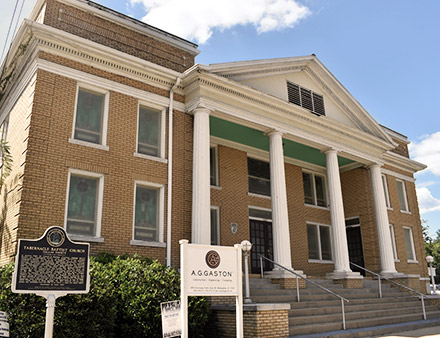
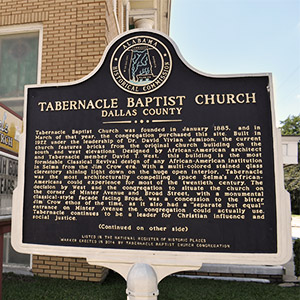
Tabernacle Baptist Church was organized in 1884 as a place of worship for the emerging middle class of Blacks and for students at Selma University. In May 1963 Rev. Dr. Bernard Lafayette began having mass meetings in the church, educating the young people of Selma about nonviolent resistance. These mass meetings were instrumental in laying the foundation for the fight for voting rights in Selma and the South, leading to Bloody Sunday and ultimately the passage of the Voting Rights Act of 1965. Historic Tabernacle Baptist Church was listed on the National Historic Registry of Historic Places in 2013
Learn More
The Edmund Pettus Bridge, erected in 1939, spans the Alabama River in downtown Selma. Named for Edmund Winston Pettus, a former Confederate Brigadier General and U.S. Senator from Alabama, this bridge has transcended its original purpose to become a powerful symbol of the Civil Rights Movement. The bridge is etched into history as the site of the momentous Selma to Montgomery Marches and the infamous “Bloody Sunday.” On March 7, 1965, peaceful protesters attempting to march from Selma to Montgomery were met with brutal force by law enforcement on this very bridge.
The shocking violence of that day, broadcasted across the nation, galvanized support for the civil rights cause and was instrumental in the passage of the U.S. Voting Rights Act of 1965. In recognition of its profound historical significance, the Edmund Pettus Bridge was added to the National Register of Historic Places and declared a National Historic Landmark in 2013. It is also an integral part of The Selma to Montgomery National Historic Trail, administered by the National Park Service. It is expected to become a UNESCO World Heritage Site in the near future.
Learn More
Get Directions
Established as the First “Colored” Baptist Church, FBC is the oldest black church in Selma. Prior to its formation, African Americans attended the church of the same name, but were made to sit in the gallery and away from the white members of the church. In 1880, the church was formed and served the families and descendents of formerly enslaved people. It is the mother church to Second Baptist and Tabernacle Baptist Church, and played and significant role hosting meetings and organizing efforts in support of the voting rights movement.
Get Directions
George Washington Carver Homes is a public housing development that was home to many residents who participated in the Voting Rights Movement of the 1960s. Brown Chapel A.M.E. is located in the center of the development, and was the starting point for the marches as well as a meeting place for organizers during the time. The church was built in 1908, replacing an older sanctuary that had stood since 1869.
Get Directions
The church was organized in 1884 by Selma University students and faculty, as well as community leaders within the African American community. In 1963, at the behest of Bernard Lafayette and Amelia Boynton, the church held the first meeting in what we now call the Voting Rights Movement.
Get Directions
The Good Samaritan Hospital was the second black hospital in the city, after the Burwell Infirmary. Good Samaritan was the only hospital in six surrounding counties open to African Americans. The hospital was an important source of employment for the Black community and aided several civil rights protests. Jimmie Lee Jackson, among other racially motivated violence victims was treated at Good Samaritan.
The Historic Jackson House was built by Dr. Richard B. Hudson in 1906 for his daughter Leola and her husband Dr. William Whitted. From the time of its construction until the passing of
Richie Jean Sherrod Jackson in 2013, this home witnessed pivotal moments in the long fight for civil rights. For almost one hundred consecutive years, it was the residence of three African
American dentists. The families that lived here hosted prominent leaders in the African American struggle for equality including Booker T. Washington, Ralph Abernathy, John Lewis,
and Dr. Ralph Bunche. Most notably, the home would play a central role in the Selma campaign in 1965 as the Jacksons opened their home to Dr. Martin Luther King, Jr. and the Southern Christian Leadership Conference (SCLC) staff throughout those turbulent months in the lead up
to the Selma to Montgomery March.
The home has since been completely moved to Michigan