Once a flourishing center of enlightenment in the 1830s, now a community of about 3,000 souls, yet still replete with about 90 antebellum structures. Marion’s illustrious past is entwined with its reputation as the “College City.” Here, five venerable institutions of learning were established. Judson College, founded in 1838, held the distinction of being the fifth oldest women’s college in the United States before closing its doors in 2021. Howard College, established in 1841, migrated to Birmingham in 1878, ultimately rebranded as Samford University. Lincoln Normal School, initiated in 1867 by nine freed slaves, laid the foundation for what is now Alabama State University. The Marion Military Institute, founded in 1842 on Howard’s former campus, remains an indispensable pillar of both local and national military education.
Read More
Sites in Marion
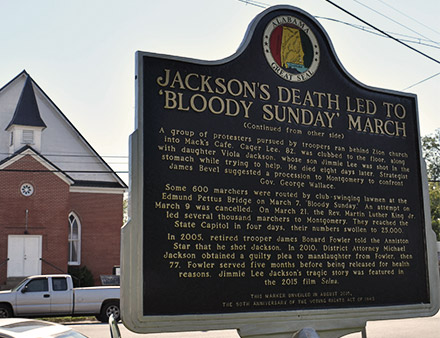
The origins of Zion Church began around 1866 as a place for newly freed Blacks to worship. The church moved to its present property in 1880. Formerly known as, Zion United Methodist Church, Zion Church would serve as a place for mass meetings to help further the civil rights of Blacks in Marion. On the evening of February 18, 1965, marchers exited the front doors of the church on their way to the Perry County Jail to show support for Rev. James Orange, who the community had heard was in danger of being taken out of jail and “lynched.” Marchers were attacked by an angry mob and some were pushed back into the church, in the resulting chaos, Army Veteran Mr. Jimmy Lee Jackson was shot by an Alabama State Trooper, who had participated in beating marchers, many of them children. Mr. Jackson would die 8 days later and his funeral was held at Zion Church with the Rev. Dr. Martin Luther King leading the service. Led today by Pastor Adrian Knox, Zion Church is still a vibrant church serving the community of Marion.
Learn More
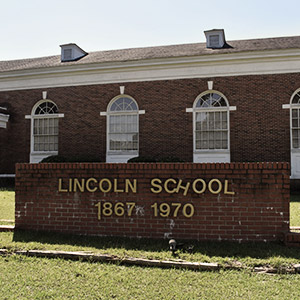
In the aftermath of the Civil War, a group of nine, the Marion Nine, former enslaved African American men, embarked on a mission to transform the lives of freedmen through education. In 1867, these men, driven by an unyielding commitment to uplift their community, incorporated the Lincoln Normal School in Marion, Alabama. Their efforts were bolstered by the American Missionary Association (AMA), a key ally in the struggle for educational equality. Lincoln would educate African American children for over a hundred years, including notable Alumni Mr. William Pettiford, Mr. Albert Turner, and Mrs. Coretta Scott King. In February 1965, students from Lincoln Normal School begin protesting the unjust treatment of Blacks in the community. Several students were arrested, along with Southern Christian Leadership Conference’s James Orange, one of the organizers of the student protests. Community members and students from Lincoln Normal School, would meet on February 18, 1965 to march to the Perry County Jail in support of Mr. Orange. Shortly after the march was started the marchers were attacked by an angry mob, in the resulting chaos Lincoln graduate and Army Veteran Mr. Jimmy Lee Jackson was shot, he would later die. Mr. Jackson’s death spurred over 4oo Foot Soldiers, many from Lincoln Normal School, on the first attempt to march from Selma to Montgomery on March 7, 1965, a day we now call, Bloody Sunday.
Learn More
Key Events
The Rev. James Orange was not local to Marion, he was born and raised in Birmingham, AL, a graduate of Parker High School, first Black High School in Birmingham. Rev. Orange was active in the civil rights movement, eventually working for Dr. Martin Luther King’s organization, the Southern Christian Leadership Conference.
Rev. Orange had seen the power of young people in 1963 during the Birmingham Campaign, he went to Marion to train young people in nonviolence and help them understand their rights as human beings. For his work in working with young people, Rev. Orange was arrested and placed in the Perry County Jail.
Word spread throughout the community that Rev. Orange was going to be lynched and so on the night of February 18th the several Black citizens of Marion, a large portion of the crowd were students from Lincoln Normal School, filled Zion United Methodist Church located a short walk from the jail holding Rev. Orange. Marchers walked out of the church headed to the jail, not all the marchers got out of the church before they were told to halt by law enforcement officials. Soon after the command to halt, the lights were turned off in the town square and the marchers were beaten by law enforcement officials and an angry mob. In the resulting chaos, Army Veteran Mr. Jimmie Lee Jackson was shot, he would die eight days later.
The arrest of Rev. Orange and the shooting and killing of Mr. Jackson led directly to the events of Bloody Sunday and ultimately the Voting Rights Act of 1965.
Many black-owned businesses were often small family-run operations but provided services and became centers for social and political activism. Black landowners used their land to support the movement, hosting meetings and providing a safe space for activists. Despite adversity, these landowners and business leaders demonstrated resilience and contributed significantly to the fight for civil rights and economic self-sufficiency.
While attempting to defend his mother, sister, and grandmother, Jackson was shot twice by Alabama state trooper James Bonard Fowler. He was eventually taken to the Good Samaritan Hospital in Selma, 30 miles away, because it was the only hospital that could and would treat Mr. Jackson. Eight days later, on February 26, he died. Jimmie Lee was buried in Heard Cemetery.